At funerals and memorials, Father liked to ask those present to share, if they could, something about their experience of the reposed. We didn’t have that opportunity at his funeral. To honor his memory and continue his tradition, I requested on Facebook that folks share something that I’d later post on this blog. Here’s the result, very lightly edited for typos. If you would like to make any changes to what you sent, please let me know. I’m also glad to add to this collection, should you want to contribute.
Thank you!
Matushka Magdalena
Bright Tuesday 2024
Over the 44 years that we were together, there were occasions when Moses said something that entirely changed the way I approached a situation.
Once, in the early years when I was complaining to him about my difficulties with my parents, he said, “Well, you’re a Christian, right? Can’t you love someone that doesn’t love you?”
Around the same time, I was unhappy with what I thought was a lack of recognition ( I think I wanted to be included more at the kliros). His observation, “The trouble with you is you think you’re something.” [not an accusation, but just a comment on the high self-regard I suffer from]
When we were facing his serious illness, he said that he wasn’t afraid of the dying, it was the getting there that would be difficult. I said I hoped that death would indeed be painless and blameless, with a good defense before the dread judgment seat. And I hoped that whatever the pain involved, it could be managed with good care. He simply asked, “Is that what you think “painless” means?” Oh. Indeed, he spent much of his time in the last year remembering many things he’d said and done, since childhood, that he regretted, repenting sometimes in tears.
Magdalena Berry
When we lived in Missouri and went to Church at Unexpected Joy in Ash Grove, we had a Pizza place in nearby Greenfield called Aloha Pizza.
Saturday night was usually one of the busiest times at the Pizza place and, one Saturday evening, a couple from town came in and sat down. When I went over to take their order, they started telling me this terrible story about how they had gotten into a car crash and how their poor, grade school daughter was in the hospital in a coma and would I please pray for her?
I said, “Of course I’ll pray for her and tomorrow morning, I’ll tell the Priest at our Church and the whole Church will pray for her!” Then I went back to taking orders and making pizza and all for the rest of the night.
Unfortunately, by the next morning, I had totally forgotten what they had said to me and what I had promised them. I was standing at the cliros, reading and singing in the choir when, during the Great Entrance, Fr Moses came out with the gifts and prayed for the usual people he prayed for at that time and whoever and whatever situations that people had brought to him…
He turned and went back into the altar, then immediately came back out, lifted up the Chalice and said, “And for all those in a coma…” and turned and went back in.
My jaw dropped as I suddenly remembered what I was supposed to have told him. I went directly into the altar and asked him, “Why did you say that about ‘all those in a coma ‘?”
He said, “I don’t know.”
I told him about the family and their daughter and that I had forgotten to tell him about it…
And he looked at me and said, “That must be why I said it.”
This was not the only time that Fr Moses, I’m pretty sure without knowing what or why he was saying it, spoke directly to something that I was thinking about or worrying about or that had happened to me recently.
And I am not the only one. Others have told me about having the same experience with him.
All I can say is, Glory to God for all things! And God is wondrous in His Saints!
Steven Berger
Our tiny church was so beautiful. It was because Fr. Moses lovingly and meticulously tended to the icons, the cloths adorning the icon stands, the patterned rugs on the floor and all manner of embellishments. We marveled that when people came to visit and stepped into the church they would sigh and say “Ah this feels like home”, no matter if they were from Russia, Greece, Serbia, Romania…
When my young children filed into church each week, they loved to look for anything Fr. Moses might have moved or added to the decor. They would find something new, then smile and motion to their siblings; a sacred version of “Where’s Waldo”.
During the years I ran a homeschool coop in my home, Fr Moses came weekly to teach the children. The class took place in the afternoon when the preschoolers napped. One day, a tiny girl woke early from her nap and stumbled into the room where the older children were crowded around Fr. Moses, listening. She rubbed her eyes and pointing to Fr Moses, she asked , “Is that God?”
One windy day, two of my sons were playing a game of catch under a huge oak tree in our yard. Luke, the older boy, heard a creaking sound and looked up to see a large branch above his brother’s head about to break. He shouted to his brother to run and he did, just in time as the branch fell and crushed a fence near to where he had been standing. The boys told me the story and showed me the damaged fence. It was shocking to see how near my son had been to certain injury. The next Sunday, the boys enter the altar ready to serve. Fr Moses greeted them then looked hard at Luke, patting him on the shoulder he said, “You know, Luke, you’re a good brother.”
Michele Latham
In the summer of 1998, I drove my car into a fescue field, parked it and got out with my two young children to walk. It was early in the season, June I think, but already hot. I was sweating as we made our way through an old wooded cemetery, passing mounded rocks and tired gray headstones. Graves of the Indians, Paupers and Slaves mentioned on the metal sign affixed to the Berry Cemetery gate.
Finally reaching a tiny chapel that lay nestled under black walnut trees at the top of a rise, we found liturgy in progress. And during the homily on the gospel, a man who spoke in parables like Jesus. In words of an otherworldly plainness. It was a way of speaking, I would come to realize, that could as easily confound as astound, often reminding me of the hard saying of the gospel. Truth that Jesus perceived was offensive not because it was in fact all that difficult to accept or understand, as the disciples claimed, but because it exposed a weakness in their faith.
When I saw him last, early in the day of his repose, Father Moses could no longer speak. It seemed that he was the listener now, relieved at last of the burden God had given him to speak. In all the time I knew him, I had only rarely seen Father Moses silent. And even then he was still speaking. That work of Father Moses’s was finished now, it was clear. And this new silence was work of a different kind. Work I was intruding on. Saying a brief farewell, I left him to it and went out to the kitchen where I could hear the familiar voices of his loved ones talking quietly over cups of perfectly brewed coffee, a sound I could not help feeling must be as good to his ear, if he could hear it, as to mine.
In the wake of his funeral, the silence of Father Moses in the hours before death has stayed with me. It contrasts sharply with the sound of his voice as I first heard it, “Remember that Jesus loves you and that he’s mindful of you,” “It’s time to become the woman you propose to be, “Take your foot up off your brother’s neck,” “You think you know? You don’t know. You can’t see the tears that are shed in secret,” speaking a hard truth while he had time, knowing that even then the day was already far gone.
Cheryl Ann Tuggle
Our nephew is a reader at the Russian Orthodox Church in Kansas City. He recently informed us of the passing of Father Moses. We know and loved and respected your husband since we first met him 1984 at the St. Herman of Alaska Brotherhood Monastery in Platina, California. Abbot Herman allowed my husband and I to attend all the priests conferences and met with and spoke with Fr. Moses many times. Throughout the years we spoke about the First Black Museum he was starting in Missouri and contributed to its formation. When I called him to tell him that we were recently back from Uganda where we were putting an orphan high school boy through school by sending funds for his education to his local priest, he said that His Church and fellowship would take over and help him go through school, which he did. We thank God for him in our lives and will cherish the memory of his jubilant smile. God Bless You.
Dr. Joanne Stefanatos-Hetzel and David Hetzel
I met Fr. Moses around 1975, he was just Carl then. I was a Methodist minister just out of seminary and working at a homeless shelter in Atlanta, GA. He was a Brown Brother in HOOM. (I still think it funny he was a Brown Brother!)
I pulled up to work one day on my 650 Triumph motorcycle, and this young black man in a long brown robe was standing on the porch. When I saw him, I knew immediately he came for me. I helped him get an apartment, we became fast friends, and we started Bible studies together. Eventually he gave me great advice about a relationship I was in and a year later I joined the Order. He saved my life. Later, when I also became a Brown Brother, I learned it was the practice in those days to take a bus to a large city with only $100 to start a mission. His faith, advice, and courage inspired me and we continued to stay in touch over the years including personal visits and OCA Assemblies, and I hosted him and the Fellowship of St. Moses my parish. I am so grateful God sent him to “get” me. I look forward to seeing him on the other side!
Fr. Thomas Moore
Fr. Moses would say “Don’t compare yourself to others because everyone has ‘six’. Some people have three plus three, some have four plus two, and some have five plus one but everyone has six.”
After he was confined to the wheelchair, it was more difficult for him to get into the altar since the church was not particularly accessible. The chair was difficult to navigate through the vestry and made a racket crashing into things. The door was hard to close behind himself and, if no one helped, noisy and it seemed to me like he felt a bit humiliated. One day, he had successfully gotten into the altar when certain ladies arrived, wanting to make confession. They asked me to go in the altar and ask him if he’d come out. With utmost patience, he retraced his same steps, making a racket and whacking things but he didn’t complain or give any sign of bother. When he was out, his chair was too low for this older lady so she, displaying similar patience and sobriety, quite stiffly got on her knees. She was still too tall for him to put his stole on her head so she hunched further and this old lady confessed, bowed to the floor like a child. When she was done, father made to re-enter the altar but a line had formed (everyone wanted to confess if he was hearing confessions) and he stayed out, hearing confessions from a crowd of people, young and old, each one crouching on the floor in front of his wheelchair because they wanted to confess to him. They all humbled themselves, he humbled himself, and I got a big blessing from watching it all. When liturgy was finished, he came out of the nave and a man in a suit asked for his blessing and said, “Anything I can do for you?” It was snowy outside and the narthex was a muddy mess and father pointed under a small table and said, “You could clean up that mess”. Without a word, this man in his suit got on his hands and knees on the muddy rug in the narthex in front of everyone coming and going, crawled under a table and scrubbed a mud mess because he wanted to do something for Fr. Moses. It seemed like the kingdom of heaven.
The evening before I was baptized, I attended the service, made my life confession, and went home. At home, I remembered something or other I hadn’t mentioned in my confession. My thoughts started to trouble me quite a bit about this and I texted Fr. Moses explaining how I’d forgotten some things and wanted to make another confession in the morning. I was very relieved to receive a nice text back saying everything would be OK and I should arrive a little earlier than planned in the morning. I was surprised because the capitalization, punctuation, grammar, etc was immaculate when most people don’t put the time into texting to write that way. I had no idea he didn’t text and sometimes struggled with writing. In the morning, I arrived early but he didn’t come out of the altar to hear my confession. Everything went ahead just fine and, when I asked him about it later, he said he doesn’t text but I shouldn’t be surprised if the Lord can do miracles using technology. He also helped me to understand confession a little better.
He seemed to give the same sermon every Sunday. He would tell different stories or use different illustrations but usually included, “Judge not, lest ye be judged”, “If you do not forgive your neighbor, God will not forgive you”, and “Unless your righteousness exceeds that of the scribes and Pharisees, you will by no means enter the kingdom of heaven.” Once he acknowledged this by telling us that, if we would take this sermon to heart and begin to live it out, he would change to a different sermon.
His sermons also usually included the admonition, “Be good to one another” and “Be a little more than you have been” or “Do a little better”.
In case no one else has mentioned this one, I think it would be a blessing to record the story about Wallace White learning to read, his slaveowner threatening him and then eventually becoming an abolitionist. He used that story as an illustration not to judge others.
Fr. Moses was strict about whistling in the church. He said that nowadays we are tempted to snicker at notions such as “Don’t whistle in church” but our great God-bearing fathers (specifically St. Ambrose of Optina) said it attracts the devil and we should have some sobriety.
Father said that when he was released from prison, he went back to his old friends wanting to tell them about Jesus. One of them (father said this man was very bad) told him he didn’t want to hear about it, saying, “When you are the type of Christian that I am a ****** criminal then I’ll listen.” His friend helped him to check himself and become serious. I once asked him what came of this man and he said that, later in life, he wanted to turn over a new leaf but didn’t know where to go or how to start. We should pray for the servant of God, Yancey.
Father was very non-possessive. He would give away anything of his at hand; if you came to his house, he would take things off his shelves and give them to you. I was edified by this and impressed that he never asked for money like some religious leaders do. One day, I revealed to him that someone had offered me a job with a much larger salary. I was nervous because I know money is “the root of all kinds of evil”. He said he thought it was OK and I took the job. About six months later, he asked me for some money (to give to some one else). My thoughts told me I should be scandalized and lose my good opinion of him but I refused. Another six months passed and I was offered an even larger salary. He had asked me for money again not long before this (again to give to someone else) and I thought nothing of it. I was in the habit of revealing my thoughts to him and I again told him I was concerned about the temptation to love money and he said, “Don’t worry about it. I’m watching out for you.” at which moment I realized that he doesn’t care one bit about my money; he was taking my personal concern to heart and watching out for me in case I should be wounded by the love of money. I was very edified at his watchful care for me, a sinner, and his discretion.
One day, I asked Father for a blessing for some podvig or other. He didn’t say no but rather, “You know what we would do if we really wanted to imitate the saints-what is mostly neglected these days but is a lofty spiritual practice? Giving thanks in all circumstances. That’s what we should do.” Later that day, my back started hurting, which was unusual, and it got quite painful. For obedience, I was thanking God for this pain and humiliation. For a week it got more painful until I wasn’t standing up straight. It was a weekday festal liturgy in the month or so before he lost his leg. I was serving in the altar, trying to stand up as straight as I could and hide the fact my back hurt, and he was serving the liturgy and sitting down between litanies because his leg hurt. At the end of the liturgy, when he blessed me to take off my robe, my back made a loud pop and felt almost completely better. What was truly remarkable-I felt-was that, despite being a temperamental and belligerent person, when my back got better, there was sadness in my heart because I was getting such a big blessing from giving thanks in bad circumstances according to my spiritual father that I didn’t want it to stop. To me, this was a marvelous change effected by my holy spiritual father.
a parishioner
I met Fr Moses 47 years ago when his name was Rev. Karl Berry, a minister in the Holy Order of MANS before we became Orthodox. He was a psychologically deep, streetwise counselor who could sum up conflicts within people in a savvy few words. One of the regrets a good many of us have is that we did not write down his quick insights into others, and why bother when fresh new ones pour out of his mouth everyday with gentle good humor.
We were blessed when he and the future Matushka Magdalena, then known as Mary Rose, moved from Boston to our small community in downtown Atlanta. Karl and Mary Rose were co-pastors with me as we built the lay Christian Community in Grant Park in the early 1980s. We each had a discipleship group – three pastors, three groups, seven lay folks in each group, 21 people in all. This was the core beginning of what became St John the Wonderworker parish on Cherokee which is so vibrant today.
My assessment was that Fr Jacob Myers, in San Francisco, was the single best pastor we had in our Brotherhood … and that our community in Atlanta was singularly best in all ways! We loved that Atlanta community and didn’t mind bragging as much as possible while still sounding humble. Fr Jacob and Rebecca agreed to come out, and they led the community into the Orthodox Church while the Berrys moved to St Louis to lead the small parish there into the Orthodox Church. (I went to San Francisco, more or less trading places with Fr Jacob at Raphael House).
The five years I spent working alongside the Berrys in Atlanta was fun and inspiring for me and others.The Berrys were the pillars of the young lay community.
One example of Fr Moses’s good sense and command of the moment was when he was drying clothes in a Cabbagetown laundromat. He saw a woman walk out of an apartment building wearing no clothes. She walked into the laundromat, went up to his dryer, opened the door, pulled out one of his shirts and started to put it on. Fr Moses said, “Put that back. Go home and put some clothes on! “ The woman never spoke a word. She took the shirt off, turned around, walked back to her apartment, put on some clothes. I said I don’t know, that would have thrown me for a loop. The gospel says if someone’s naked you clothe them. I would have been hard pressed not to let her take something. Fr Moses said “The problem wasn’t that she didn’t have any clothes. The problem was she was out of her mind.” Sounds so simple when he says it, but it was typical of his ability to confront insanity anywhere he went. No ideological overthink. He was animated by the truth. He said if you stand in the Truth – and not many people want to, he added- everything can be faced. That’s how Fr Moses was everyday, every conversation, with great humor, unless you were the one talking confusion or acting out of your mind.
Another time he visited Raphael House with the neck chains that were used by slave masters for transporting enslaved children. “We had them in our house when I was growing up. We used them for doorstops.” He didn’t give them much thought as a kid, realized later how unusual it is have something so shocking, so strange and historical as family heirlooms.
Fr Moses gave me so much great advice that I took to heart but have long forgotten the specifics.To say we were close friends would miss the mark, not capture it at all. We we were brothers in Christ, the depth of that is sense shared by so many other priests and clergy over the years as well. Fr Jacob Myers was this way, both of them similar in this regard. I’ve met countless people who felt that Fr Moses had a special rapport with them, which is something we feel on our end. He was that way with everybody.
Fr. David Lowell
One story I remember is that, when we were in Detroit together, Father Moses worked in a drug treatment center in downtown Detroit. He would take the bus home at night. One night on the bus a group of young men started hassling Father Moses ( he was in his clerics) and out the blue there came a ragged giant black man from the back of the bus. He came up to this group pointing finger and shouting “no” to them. It was as if God sent a helper in the guise of this humble giant to his aid. I can fondly remember Fr. Moses chuckling as told this story.
Natalie Williamson
I remember Father Moses saying a short sermon at a wedding at St. Thomas. His advice to the couple marrying was: If your spouse and you walk on the road and one of you says, “Let’s go on the left side of the road,” don’t argue and walk on the left; if another says, “Let’s go to the right side,” say, “As you wish,” and go on the right side. Then you’ll have peace in marriage. That simple advice stuck with me.
Aida Zamilova-Judah
My most poignant experiences were the times he came to Nashville to show the effects of the pain and chains related to slavery. He was not only joyful in his demeanor but specific, engaging, and dedicated to showing the pain many suffered due to slavery. Missing his smile.
Presvytera Marion Turner
Father Moses: Pray for me. Pray for my children.
These are things Fr. Moses said, as I remember them:
Treat others truly the way we want to be treated. We must begin to train ourselves to see other people as saints. Loving kindness can be lasting long after us- these words come from the people who have learned not to put their trust into the worldly things. Otherworldly people are free from the ties of this world. It is a life of an adventure to see brothers and sisters in everyone.
Fr. Moses grandma‘s words, “ I am not colored. I wasn’t dipped nor dyed. Iced water of white people isn’t colder than ours.” Relying on this world moves us further from God. In order to grasp the whole field with the pearl, we need to think differently, to cultivate a new way of thinking, how not to use this world to change.
We want to be people that other people want to follow, to enter the Kingdom of Heaven.
Talk to yourself, ask yourself, “ How should I treat this person who I see on the street?”.
Do not be ashamed of your life, repent. People are OK because we are children of God. He will never leave us. Be more of a man, don’t let yourself to be engaged into a conversation which is wasteful.
I need love, so I bring it to others. You made me love you, I didn’t. Society is not a guide to Christians. Love and keep praying for people.
[We need a ] Look of acceptance and the kind smile (on our faces) We miss the love from God that our neighbor could give us. Be with people, take and give love.
Be a helping hand. Accept a helping hand. Go the extra mile.
Every time we say to Jesus, “I am sorry, forgive me” , He believes us! We make a promise, and consciously, deliberately break it. We hurt Jesus, he is bleeding.
Meet people and share love. God gave us many gifts and He will ask how well we used them.
Other people believe in Christ, but they have “missing pages” from their faith book. They don’t know Mother of God. The Holy Virgin doesn’t judge and can appear to anyone.
Do not “tag” people, see brothers and sisters in everyone. Be a better man, than you are now, practice, no time for excuse. We have all the pages ( in the book of our, Orthodox faith). We have to yearn to be better. We are so bound up with each other that, if we connect, we feel each other. We all suffer, if one suffers. There are invisible wounds. Hard to get over own mind. Pray for people you have bad feelings about and check yourself to make sure you don’t judge.
Fr. Moses advised to read the Philokalia in order to know how to develop a discernment – ability to distinguish who to flee from, who to help. But pray for everyone. Everywhere, where we go, whatever we do, God is with us. Our goal (and it is hard) – we have to want to go to Heaven, but we want little things, because it’s easier ( like politics).
From the seminar with Fr. Moses on January- February 2021.
Natalia Forni
Years ago, when Fr. Moses had a museum, and Ginny Smith had a Coffee Shop (both in Main Street, Ash Grove), he would come get a Biscotti from the big jar on top of the pastry showcase. And always stayed to visit, sometimes say a little prayer. Also, he married my son (Robert Alan Carter and his wife, Deb, right there in the museum. The ceremony was beautiful with his words of love and wisdom. The day before Valentine Day was an easy one to remember.
Nedra Ann Barkley Bouling
A Seed Planted
Verily, verily, I say unto you, Except a corn of wheat fall into the ground and die, it abideth alone: but if it die, it bringeth forth much fruit. He that loveth his life shall lose it; and he that hateth his life in this world shall keep it unto life eternal.
John 12:24-26 KJV
Brooke wanted to visit Fr. Moses today. It was the first time we visited his grave. As we approached and while we stood there I began to weep. I was looking at the chapel, the birthplace of our parish, and looking at the icons he had Brooke hang up while he was in the hospital. I thought about all the tasks we would do for him when he wanted to tidy it up, paint it, reorganize it, etc. My heart broke as I realized the fact that there would be no more calls to us asking us to do this and that task for him.
Fr. Moses brought my family into the Church and was a loving father who taught us naturally as a father teaches his children. He showed us the Faith as a father naturally shows his children how to live by being a living template of what it means to be a man. He comforted us through many times of brokenheartedness. He cared for us even while he himself was in need of care. A recent story that someone told me showed me that even on his deathbed he was watching out for my family by giving this person instruction to do something for us, but told her to wait until he was “Home.”
We miss him greatly. We miss knocking on the front door and hearing him say, “come in, come in,” while he was sitting at the table on the computer. We miss him calling us to ask him to do something for him. We miss his voice. We miss silly jokes, Princess Bride quotations, and his laughter. We miss his homilies. We miss his impromptu words of wisdom. We miss hearing his beautiful voice singing out parts of the Liturgy-we always loved hearing him say quietly, “though there stand by Thee thousands of archangels and hosts of angels, the Cherubim and the Seraphim, six- winged, many-eyed,” and then singing louder, “who soar aloft, borne on their pinions singing the triumphant hymn, shouting, proclaiming and saying…” We miss him.
We miss him and yet I am not despondent as I had thought I would be when we came close to losing him in the past. During those times my mind went to dark places fearing what I would be like when the time came. During the week leading up to his repose, I had broken down many times. Yet since he has passed I have had more peace than I thought possible. I feel/know that he is with us, that he is hearing our prayers and praying for us, and it is this experience which has given me the peace I did not think possible.
Fr. Moses was a true father to us and innumerable others. We were all blessed by him during his life. I have learned that there a many who never even met him and yet say that they have been shaped by by him through his Facebook posts (he would refer to it has his “website”) and/or by his videos on Youtube. And even now we will all continue to be blessed, along with many more, through his prayers and through all that he has handed down to us in his life and words. I pray that my life might imitate his life inasmuch as his life imitated the Life of Christ.
I know that I have been given a great gift by having Fr. Moses be the spiritual father of myself and my family. I know that losing him is heartbreaking, but I also know that now, as the seed has died and been planted in the earth, an abundance of fruit will spring forth from this holy man.
John Pearlstein
My favorite quote of his that has stuck with me from childhood “Where ever you go, there you are.”
Julianna Campbell
One day Fr. Moses said to me: “It does not matter where you go, because you always bring yourself with you” – completely truthful.
Tatiana Goris
I could share one particular memory of Fr. Moses when he shared his own story if coming into the Orthodox Church and his family legacy. He spoke this with priests and others at the Diocese of the West Mission Deanery Retreat a few years ago. It was amazingly inspirational. The group I brought to the Mission Deanery from our church was deeply moved by his talk. I have known Fr. Moses at least 40 years of my life and have always regarded him as a true man of God. Memory Eternal to my dear brother in Christ.
Fr. John Tomasi
I had come from another jurisdiction after an absolutely horrible experience with a senior cleric in a position of authority who had abused me and my family and I was ready to give up. I came to Ash Grove just to figure out how to move forward when Fr. Moses showed me extreme grace and acceptance. At my first liturgy with Fr. Moses I told him that I was tired, hurt, and exasperated, and that I just wanted to stand in the corner and watch. He said “I’m sorry, we don’t have any corners in this church”.
When I was at my most frustrated I told him that I thought I was done with the priesthood and some of the megalomaniacs who often wear gold or jeweled crosses and he said “Fr. Samuel, it’s always been that way. Just be patient and wait and God will fix this. Until then you are welcome here.” Now, almost 5 years later, I can say he was right about everything. I will miss him until, God willing, I see him again.
Fr. Samuel Seamans
His laugh, his memory of oldies music, his gentle ways of correcting me instead of shaming me during my worst times. Always optimistic, a man of integrity, his commitment to his family history.
Rick Downer
My last conversation with him, he prayed for me as I drove to my new assignment in Wilmington, North Carolina. Father never failed to encourage me, especially in my work as a nurse.
“You may be the only person to show your patient any kindness,” he’d say to me.
He who had shown such kindness to me throughout the years. Always there with a gentle word and a twinkle in his eye.
Memory Eternal Father Moses
McKayla Cochran
One week ago, Fr. Moses Berry, my spiritual father, friend, confidant, and co-struggler, went to be with the Lord. His life and some of his works can be found by clicking here. My departed Matushka Michaila (+3/13/12) and 12 others were led into the Orthodox Faith by him in 1993, with the help of Fr. James Dank.
He and his Matushka Magdalena have been dear to us since that time. The first Orthodox monastery in Missouri was established from land he donated to the nuns back in 1998, that had previously been ancestral property from the 1800s. Since that time he has consistently been a guide and father to me and many others.
He became the first president of the Fellowship of St. Moses the Black, which emerged out of the Ancient Christianity and African American Conferences, where Black Americans have been discovering the riches of Ancient Orthodox Christianity, and Orthodox Christians have been discovering the depth of spiritual treasures from Africa and African Orthodoxy and the Black experience in the Americas.
Fr. Moses lived as a truly good shepherd in Christ-like fashion. He had a gift to see the good in the person in front of him and helped that person on their way. To the last week of his life, he was ministering and giving out of his suffering to whosoever would come to him. He was the one who kept “laying his life down for the sheep” (John 10)
Matushka Michaila and I were very close to both he and Matushka Magdalena. Because our marriages were a bridge of reconciliation, sometimes people would confuse who went with who! One of the most powerful lessons he taught me was to be ‘reconciled to my humanity.’ I needed to look at my father, mother, my generations and accept who i am. I needed to realized that each one was doing the best he or she could given their situation and find out what good came out of it. It reminded me of the words of the Lord to Jeremiah, “when you extract the precious from the worthless, then you will be my spokesman’ (Jer.15:19 NASB)
As he buried Matushka Michaila, we were present to bury him in the same cemetery on the 16th of January, 2024. Archbishop Daniel of the Orthodox Church of America presided. 14 priests, including two abbots, and one deacon served at this funeral service. Another three priests were in attendance. Over these days 40 liturgies will be served by priests who loved him across this country and abroad. Memory Eternal, Fr. Moses. With the saints give rest O Lord to the soul of Thy servant.
Fr. Alexii Alschul
Poem: Deep River
Memory Eternal Fr. Moses Berry
August 20, 1950 – January 12, 2024
By Mat. Elizabeth Perdomo
It is a deep river,
that great divide, that
wide Jordan which
separates life
from life, time
from eternity.
We weep upon
Sac River shorelines,
upon that curved
boundary
we cannot yet
cross.
Here, while we hang
tears, weep lyres
of sorrow,
you sojourn away
from mortal homelands towards that eternal
sacred campground.
You sing joy, but
just beyond our
sight.
You no longer live here,
but now know clearly,
see things beyond
our streaked
vision.
Even so,
today we mourn
with warm streams
of grief.
We remain
so bound up,
there will
surly be a day,
some other time,
when we will again
sing joy, once
more together,
forever.
13 January 2024 – Cayce, SC
Father Moses Berry, as he was known to most people, was a special Priest who in his limited time on this earth has gone full circle and found Christ as the Savior and the Orthodox Church as the true custodian of Christ’s teachings. Following his acceptance into the Orthodox faith and subsequent ordination as a Priest, through his personal experiences and intellectual acumen, Fr. Moses witnessed Christ to everyone who has come across him.
My wife Tessy (Elizabeth) and I, along with our children Susan Doris Antony, John Lee Abraham, Michael George Abraham, their spouses, and their children all have interacted with Fr. Moses one time or the other. Each encounter could be described as edifying in terms of our spiritual growth. Even as he was facing serious health challenges, he held on to his faith, just as Job the Prophet did. When asked how he was feeling, he would say with a smile, “I’m fine.” He often reminded us “not to ask God why we face various infirmities.” As the Book of Job so aptly tells us, “People must trust in God, even in the face of adversity, because everything happens for a purpose.”
On January 10, 2024, Tessy and I along with our son John Lee and his family were returning to Springfield from a trip to India. En route we learned that Fr. Moses had received the Sacrament of Unction that afternoon, administered by six priests including three that had received the Sacraments of Baptism and Chrismation from Fr. Moses!
We landed at the Springfield airport that evening and dropped our luggage at our home. Tessy, John Lee, and I visited Fr. Moses at his house. He was struggling but recognized us, called John Lee by name, and prayed for us. We, too, prayed briefly and said goodbye to him. We never thought that it would be the last time we would see him on this earth, as he was called to his eternal home on January 12.
We sorely miss Fr. Moses. While grieving, we also realize that he is with his Creator in heaven, watching over us and interceding for us. His memory remains eternal. As we drive to Church every time crossing the railroad on Frazier Avenue and look across the field, we cannot escape seeing Theotokos “Unexpected Joy” Orthodox Church in the town of Ash Grove, serving the spiritual needs of so many faithful. Indeed, the fruits of Fr. Moses’ labor is at work! Praise God.
Yohannan T. Abraham
Thinking about Fr. Moses, his smiling face comes first. Whenever we ask him “How are you Father,” all the time he would say “I’m fine.” Never any complaints.
His typical advice was to “Not to ask God, ‘Why?’”
One of my favorite saying from Fr. Moses was his advice to Yohannan, “Treat your wife like a princess!”
Even on his death bed, two days before he reposed, we were fortunate to see him and receive his blessings. When I think about him, I feel like he is still with us. It is hard to think he is gone.
Father Moses, Memory Eternal.
Tessy Abraham
It’s hard to put into words what Father Moses was to me…
When their family first moved back to Ash Grove, Elijah and I became good friends at school and I was quickly taken into their fold.
I remember going over to hang out and Father Moses would give me little tidbits of knowledge. At 13 they don’t sink in as much as you realize they should have later in life. But he always was there. That winter my grandpa passed away, who for all purposes was my dad.
I think Father Moses saw that, and he took the initiative to make sure I had that role model and guidance in my life. I remember standing and lighting a remembrance candle in the little chapel by the cemetery, with Father Moses standing there hand on my shoulder, saying a prayer with me.. Looking for that peace after such a devastating loss.
In him and Magdalena I had a place where I was always welcome, and I was always going to get solid advice. I was going to get corrected when I was in the wrong. Looking back I see now how much impact he(they) had on my teen years.
He kept me busy with projects around the farm, the cemetery mowing, the museum projects. He always put people in my path that would give me opportunity to better myself. Sometimes I stupidly squandered those, but he made them available, time after time.
I remember the great stories he would tell, about his heavy chevy Malibu, about figuring out a business painting appliances, meeting Magdalena, growing up on their farm, playing baseball with my grandpa.. He didn’t sugar coat things either. He was real, he was honest about his mistakes and failures, and yours too. But he made them all a lesson.
I remember when Elijah was living in New Mexico, Father Moses called and asked if I could run over and help with something. I got over there and he was wanting to load Eli’s motorcycle into a courier’s box truck to ship down there. After suggesting we just push it up the ramp, Father Moses fired it up, took it down the street, and then came back… He allllllmost made it all the way up the ramp, before he gave it a little too much and popped a wheelie, leaving him and the bike on the ground next to the ramp. Now, a robe wearing reverend with a big flashy cross flying through the air on a bike like Evil Kneivel is not something most people get to experience, but thanks to him, I did.
He got up, brushed himself off and we pushed the bike into the truck. He said, I guess that didn’t work, and went on with life. Two good lessons in one.
I also remember standing in the living room of their home, and asking about the iron shackles in a display cabinet. He then placed them on me, and I will never forget the humbling feeling of that. How horrible humans can be to one another. And how you can take adversities, then turn them into something so great, like a museum, a historical landmark, and a legacy of a life, like his.
The last time we talked he was in the hospital, short of breath and tired. But even in that state he was giving me advice, not asking for pity, but giving that guidance, because he was a FATHER… a DAD. I see now that I’m older that he set my compass toward a Godly life, toward being a good human, toward being a good parent and spouse, though sometimes I mess it up, it always finds its way back to true north.
I love him (and Magdalena) just like parents. They were there through so many growing pains for me, always with solid advice. They are my family and always will be. I thank Elijah and Dorothy tremendously for sharing them with me, even through my awkward “FUBU” years.
I moved to another state after getting married and having kids come along. When I go “home” they are always one of my main stops I have to make. When I was deciding if I should take this leap, he was there cheering me on, saying “Why not? It’s your adventure!”
So, while I miss him and his advice, it will always be near and dear to me, and guide me through my life. I hope I can always make him proud.
Joey Neimeier
Fr. Moses had a rare ability to help people feel calm and hopeful in the face of pressing emotional issues. I witnessed this effect when I first met him in 2009 at the Ozarks Afro-American Heritage Museum in Ash Grove, Missouri. I had recently begun a faculty position in the anthropology at Missouri State University and had read about Fr. Moses’ work. He and his family had recently restored the Berry Cemetery, which was established in the late 19th century by his great-grandparents for the burial of “slaves, Indians, and paupers.” Fr. Moses had also established the Ozarks Afro-American Heritage Museum (OAAHM), where visitors learned about the history, culture, and daily lives of Black Americans in the Ozarks through the lens of Ash Grove’s Black community. This community included his ancestors, who arrived in the 1830s as enslaved Black pioneers.
As an anthropologist interested in cultural heritage, I was eager to meet Fr. Moses and learn from his work. When a colleague offered to introduce me to Fr. Moses at the Ozarks Afro-American Heritage Museum, I jumped at the chance. On the scheduled day, I drove to Ash Grove with my colleague and one of our students who was particularly interested in Black history in the Ozarks. On the drive, the student told us that she was extremely stressed about her marriage. The young woman had an unconventional background. She had grown up in the foster care system and was now married, raising three children, and commuting 2 hours daily to Missouri State University while maintaining a 4.0 GPA. In the context of her coursework and daily commute, her marriage was under strain. We listened attentively and offered supportive feedback, as we wanted to support this remarkable young woman in her academic journey.
When we arrived at the museum, Fr. Moses greeted us warmly, asking us about ourselves and then starting the tour, which took us through the lives of his ancestors and their world, and in so doing, gave voice to the Black communities that had largely been heretofore omitted – erased – from representations of the Ozarks. The family heirlooms, photographs, paintings, documents, and other exhibited objects were meaningful components. However, anyone who has taken the tour will tell you that Fr. Moses himself was the most important element. In leading us through Ash Grove’s Black heritage, Fr. Moses did more than provide a narrative of past events, places, and people; he revealed the personal experiences and transformations through which he came to reclaim that heritage. And in talking about ancestors, community, family, and self, he communicated an empathy and compassion that extended to each of us as individuals and as human beings. It was about the present as much as the past, about us as much as our ancestors, and about the web of relationships that connect humans in all times and places. As such, the tour was an experience of what it means to be human.
In the car on the way back to Springfield, my colleague and I were animated and chatty. Our student, who had earlier described her struggle, was calm and quiet, but then said, “I feel so much better now! I felt like Fr. Moses was talking to me personally about the relationship issues I am struggling with right now. I feel like I will get through it all and my family and I will be OK.”
Over the next 15 years, I observed this phenomenon among many students after a tour with Fr. Moses at the Museum or the Berry Cemetery. I recall an Indigenous student struggling with feelings of isolation, a single mom dealing with financial insecurity, a first-generation college student uncertain about his ability to succeed in college, and an immigrant student who felt out of place. I also recall myself – worried about raising my child, gaining tenure, or coping with the death of my mother. Each of us arrived for a tour or presentation and departed with a new sense of calm and confidence about our ability to persevere and even succeed.
How did the experiences with Fr. Moses affect these transformations? Was it his gentle voice and movements, which put us at ease? Was it his talent for storytelling, which fully captured our attention? Was it his sense of humor, which allowed us to see him as a “regular guy” as well as a cleric, heritage educator, and community leader? Was it his practice of looking each person in the eye and asking them a meaningful question, which created an inter-personal bond and communicated genuine interest in each of us? I still cannot say just what quality or combination of qualities account for Fr. Moses’ ability to make each individual feel seen and valued. I do know that this is one reason I miss him, and one way in which Fr. Moses still helps me make my way through the world.
Liz Sobel, 4/28/24
One day, early in my time with Orthodoxy, I visited father Moses at his home by the church in Ash Grove. He was happy to show me around his home, telling me about the history behind many of the antiques he had on display.
At that time, I was in a very dark place. I don’t mean to exaggerate, but it was by far the darkest time in my life. Many of my friends from church had encouraged me to reach out to father Moses. They told me about the many times they had called him on the phone when they were struggling through a difficult problem. As such, I was very pleased to be visiting him, and I opened up to him about some of the horrible trouble I was in.
He gave me some good advice and told me how to pray about my problems. I had recently started doing morning and evening prayers to practice the Orthodox lifestyle, so father moses also gave me a little Myrrh incense to take with me along with some firewood as I had run out.
All these things he had given me, though he new very little about me. I was almost a stranger to him, but he shared the beauty of his world with me.
Before I left that day, I asked him for help with one last thing. On top of everything else that was going on, one of my pets had recently passed away and he allowed me to borrow a shovel and to bury it by a tree in his field.
Fr. Ephraim’s family drove by and saw me digging in Fr. Moses’ field. One of Fr. Ephraim’s little ones saw me and asked her mother if she could bring me some cold water to drink. They came back a few minutes later and their little daughter brought me a big jar of ice water, handing it to me through the barbed wire fence. Her joy in helping a stranger was familiar to me. It was the same joy I saw in Fr. Moses.
It was a sweltering summer day. It had not rained for a week, and the ground was hard. I broke the handle of the shovel while stupidly prying at a stuck rock and regretfully informed him that I had broken his tool, but he just said, “That’s ok. Tools break sometimes.”
I hope that some day I can be a “Fr. Moses” to someone who is lost. I hope I can be like him and give of myself to someone else when they are in need. I want to be what he was: an oasis of God’s Grace in this dry dry desert.
Dace Robertson
The first time I met father was after a church service at ash grove. I had seen him at some joint services with St Thomas but we never spoke. My family and I had come to church after not going for an extended period of time due to a poor experience with another priest. I came to Ash Grove weary, suspicious of anyone in priest’s clothing if I’m honest. I went up to kiss the cross and father looked at me and said “Are you a model?” I couldn’t help but giggle. He broke the tension right away and it was the start of a relationship that would change my life. He would always encourage me in everything I did. I came to him with all my questions, fears, and flaws. He would tell me I reminded him of Dorothy in many ways, which I believe is the highest compliment he could have paid me. When it was time for me to go to college and I said I would be attending University one Nashville, Tennessee, he told me he had good friends there (the Smiths) and that they would take care of me. I later learned that he called the Smiths, told them about me, and asked them look out for me. The smiths always joked that they were told they had to look out for me or they’d be in trouble with Father Moses. I would come home over the years and he would always greet me with a smile, twinkle in his eye, and a hug. And sometimes a word or two, “My dear red is your color!” Or “You look stunning McKayla, and I can say that because I’m an old man.” When I called him to tell him I’d decided on my first job, I expressed some guilt at not moving back home to be closer with my family. He said to me, “Oh don’t worry about it. I think you’re doing good staying where you’re at. I wouldn’t wish Springfield on anybody.” The last time I spoke to him I was on my way back east to start my next assignment. He asked me, “How’s that nursing thing going?” I said pretty good and I was sorry I didn’t get to see him when I was home. He told me it was ok and then the physical therapist walked in so he had to go. He prayed for me and we said goodbye. I had no idea it would be the last time we spoke and I’ve never been more thankful for a phone call. So thankful for him and all he gave me.
MyKayla Cochran
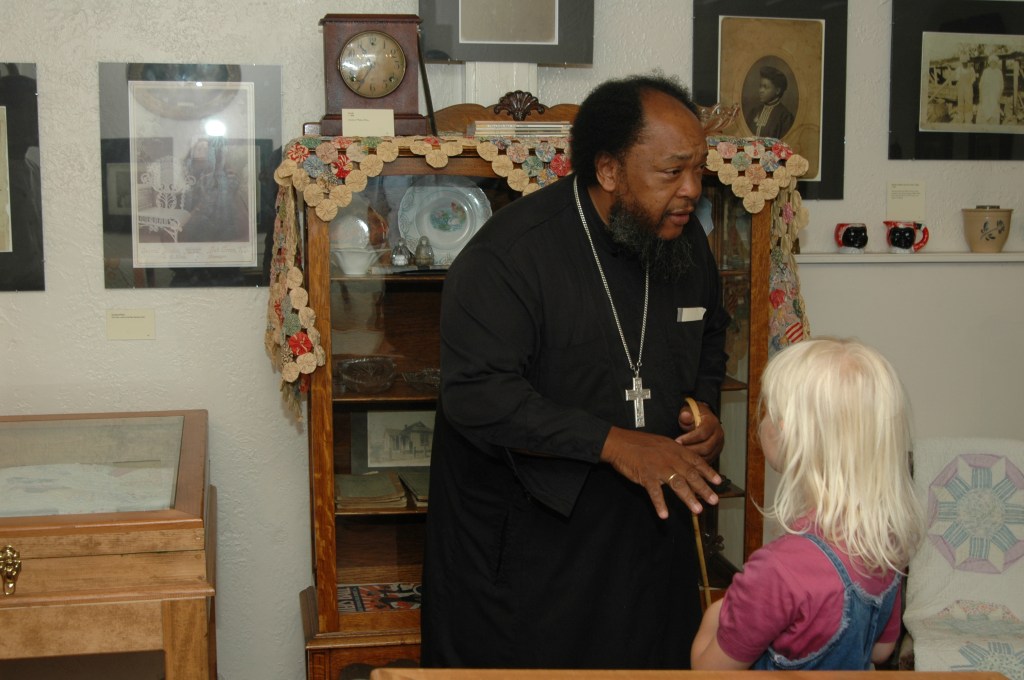


 Father Moses Berry